Home Loan Eligibility Calculator — salaried and business
Every field, the formula behind it, and a worked example.
Last updated:
Help › The calculators › How much a bank will lend
The ceiling, worked out the way a bank works it out — and worked out twice, because a bank does not read a salaried file and a business file the same way.
 Open this calculator
01
When to use it
Before you walk into a bank, and before an agent talks you into a price. Knowing the ceiling saves an embarrassing conversation later.
02
Every field, explained
| The tab at the top — salaried or business | Pick the one you are. The fields change, because the proof changes: a salaried man is read off his salary slip, a businessman off his tax return. |
| Monthly income (Rs) | Salaried: what reaches your account after tax, not the gross on the offer letter. Business: the net profit your tax returns show, divided by twelve — not the shop's turnover. Banks usually average the last two or three years. |
| Other monthly income the bank will count (Rs) | Rent that comes in, or a co-applicant's income. Only what can be proved on paper — the bank will not take your word for it. |
| Instalments you already pay (Rs) | Car, personal loan, credit card, committee. A businessman adds the business's own instalments too — running finance, a leased vehicle, a machinery loan. |
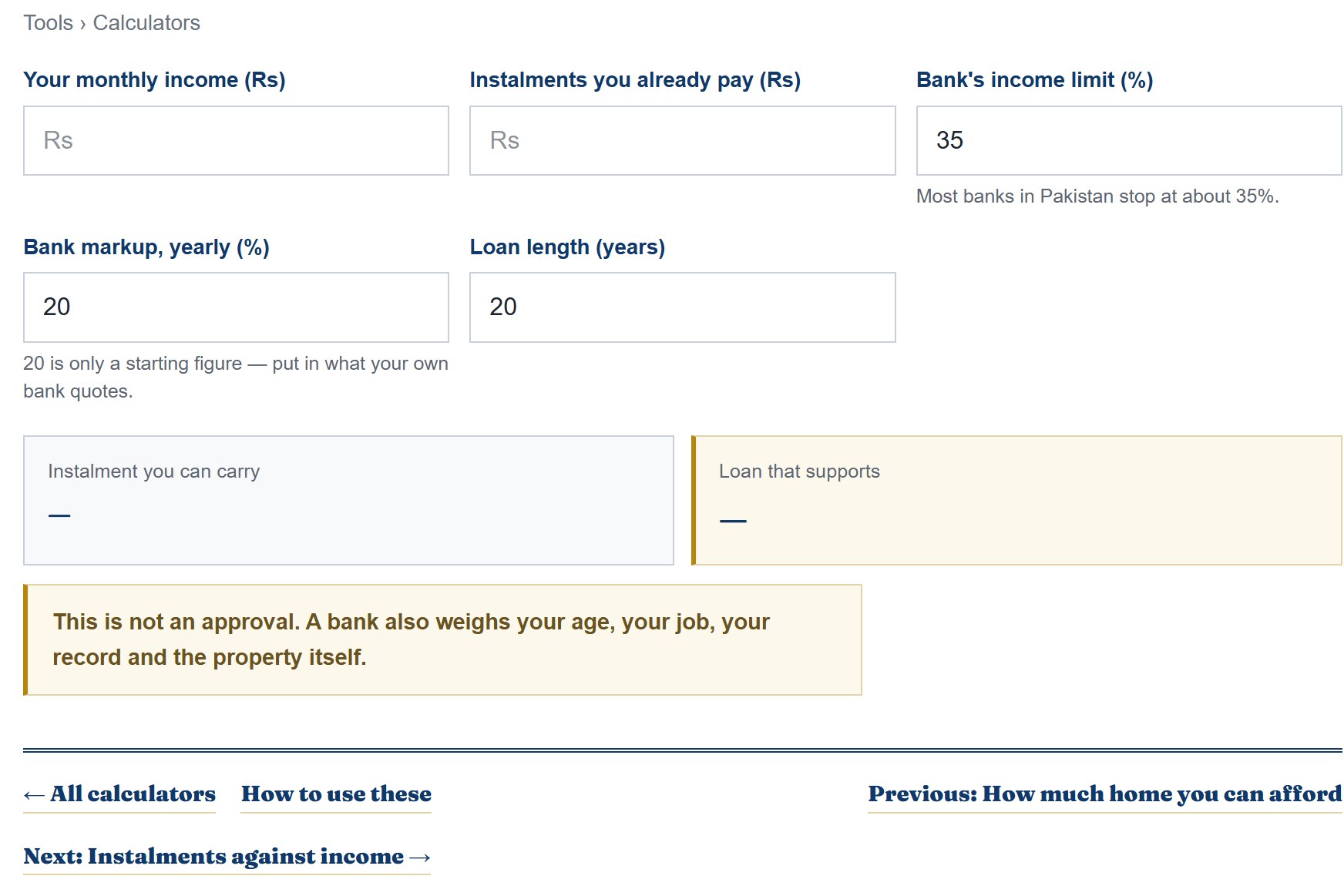
| Bank's income limit — DBR (%) | The share of your income a bank lets go to instalments. It starts at 35 because that is roughly where most banks in Pakistan stop. Against business income banks are usually tighter, because that income can fall. |
| Bank markup, yearly (%) | Your own bank's quote, not a guess. The 20 sitting there is only a starting figure. |
| Loan length you want (years) | Longer term, bigger loan for the same instalment — and much more markup. |
| Your age today, and the age the loan must finish by | This is the field most people have never thought about. A bank wants the last instalment paid before you retire — usually 60 for a salaried borrower, often 65 for a businessman, who has no retirement date. If your age leaves fewer years than you asked for, the calculator quietly shortens the term and the loan shrinks with it. |
| Months in your current job / years the business has been running | Banks ask for continuous service — some accept six months, many want two years. For a business, most banks want three years, with tax returns and bank statements that agree with each other. |
| Price of the property, and how much of it the bank finances (%) | Optional. Fill it in and the calculator also applies the second ceiling: a bank never finances the whole price. Whatever it does not finance, you pay yourself. |
03
How the answer is worked out
- Your income — salary or declared business profit, plus any other income the bank counts — is multiplied by the limit percentage. That is the most a bank will let go to instalments.
- The instalments you already pay are subtracted. What remains is the instalment you can still carry.
- Your age is checked against the age the loan must finish by. The term used is the shorter of the two: what you asked for, or the years left to that age.
- The instalment formula is then run backwards to find the loan that instalment would service at your markup and that term.
- If you entered a price, the loan is capped a second time at the share of the price the bank finances. The lower of the two ceilings is the answer, and the rest of the price becomes the cash you must put in yourself.
A worked example
| Salaried, age 45 | Loan must finish by 60 |
| Monthly income | Rs 500,000 |
| Already paying | Rs 60,000 |
| Limit | 35% |
| Markup | 20% |
| Term asked for / allowed | 20 years / 15 years |
| Instalment you can carry | 500,000 × 35% − 60,000 = Rs 115,000 |
At 20% over 15 years that instalment supports roughly Rs 65 lakh — not the Rs 67 lakh it would support over 20 years. Those five years of age cost about two lakh of loan. Add whatever cash you have, and remember the transfer cost still sits on top.
04
Mistakes people make
- Using income before tax and deductions, or a business's turnover instead of its declared profit.
- Forgetting a committee or a family loan — a bank will find it on your statement.
- Leaving your age empty. It is the one field that can quietly cut the answer.
- Treating the answer as the property price. It is the loan; your own cash is added separately.
- Raising the limit above 35% to make the number look better. The bank's limit does not move because you typed a bigger one.
05
What it does not do
- It is not an approval. Banks also weigh your credit record, your employer or your trade, and the property itself.
- It does not know whether the bank will lend on that particular plot or house — in Pakistan banks rarely finance a bare plot.
- It ignores processing fees and insurance, which reduce what you actually receive.
- It says nothing about whether you should borrow that much.
06
Questions
- Why are salaried and business kept separate?
- Why 35%?
- My business earns well but I declare little. What do I put in?
- How is this different from the affordability calculator?
- Can I improve the answer?
Because the bank keeps them separate. A salary slip proves income month by month and the job ends at retirement; a business proves itself through tax returns, needs a few years of history, and carries no retirement date. Same bank, two different files.
Because that is roughly the ceiling most Pakistani banks use for total instalments against income. Some go higher for high earners, some stop at 30, and business income is usually treated more tightly. Ask, then put the real figure in.
Put in what you declare. That is the only figure the bank can see. Anything above it feels good on this page and disappears at the bank's desk.
This one stops at the loan. The affordability one adds your own cash on top and tells you the property price you can look at.
Clear a running instalment, add a co-applicant's income, or lengthen the term — if your age allows it. The first is the healthiest of the three.