Keep It, Build On It, or Sell It — an empty DHA plot, three ways
Every field, the formula behind it, and a worked example.
Last updated:
Help › The calculators › Keep, build or sell
An empty plot is not a neutral thing to own. It grows, it costs a penalty, and the money sitting in it could be doing something else. This lays the three roads side by side over the same years.
 Open this calculator
01
When to use it
When a plot has been sitting for a while and the argument at home keeps going in circles. It will not settle the argument, but it puts the three answers in the same units.
02
Every field, explained
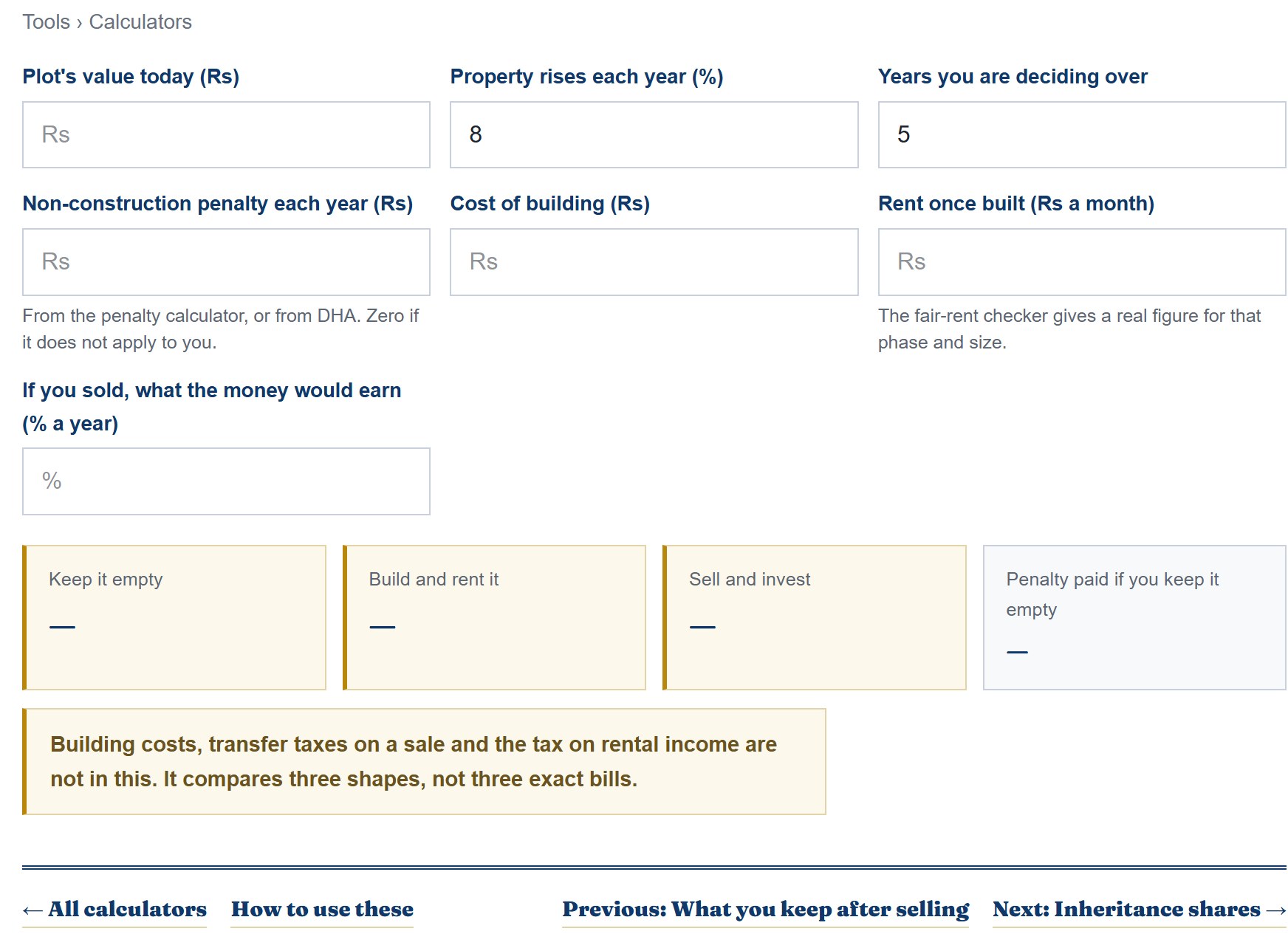
| Plot's value today (Rs) | What it would fetch this month, not what you paid for it. The market report on this site gives a per-marla figure for each phase. |
| Property rises each year (%) | A guess, and the single most powerful number on the page. Try it low and high before you decide anything. |
| Years you are deciding over | How long you would realistically hold either way. |
| Non-construction penalty each year (Rs) | From the penalty calculator, or from DHA. Zero if it does not apply. This is the only certain number here. |
| Cost of building (Rs) | The construction-cost calculator gives a working figure for the covered area you have in mind. |
| Rent once built (Rs a month) | The fair-rent checker gives a real figure from live listings for that phase and size — better than a guess. |
| If you sold, what the money would earn (% a year) | Whatever you would honestly do with the money — savings, another plot, a business. |
03
How the answer is worked out
- Keep it empty: today's value grown at your growth rate for those years, minus the penalty for every one of those years.
- Build and rent: plot plus construction grown at the same rate, plus the rent collected (from the second year — the first goes on building), minus what the construction cost you.
- Sell and invest: today's value grown at the return you said the money would earn.
- The largest of the three is highlighted. That is all the calculator claims to know.
The lesson, not the number
| Plot today | Rs 2 crore |
| Growth guess | 8% a year |
| Years | 5 |
| Penalty each year | Rs 50,000 |
Change the growth guess from 8% to 12% and “keep it” wins; drop it to 4% and “sell and invest” wins. The penalty is the only figure on the page that is not a guess — which is exactly why it deserves more weight than it usually gets.
04
Mistakes people make
- Using the price you paid instead of today's value.
- Putting the same growth rate on property and on the money you would invest. If you believe one, you have to argue for the other.
- Leaving the penalty at zero because nobody has asked you for it yet.
- Treating the winning answer as a fact. It is arithmetic on a guess.
05
What it does not do
- It leaves out transfer taxes on a sale, tax on rental income, and the years a house sits empty between tenants.
- It does not know whether you can get the construction finance.
- It cannot price the thing people actually decide on — whether you want to live there.
06
Questions
- Why does rent only start in the second year?
- Which number should I be most careful with?
- Does it include the rent I would save by living in it myself?
Because the first year goes on construction. It is a rough allowance, not a schedule.
The growth rate. It moves the answer more than anything else, and nobody knows it.
No. If you would live in it, put your own rent in the rent box — that is what you would be saving.