Inheritance Share Calculator — a plot divided among the heirs
Every field, the formula behind it, and a worked example.
Last updated:
Help › The calculators › Inheritance shares
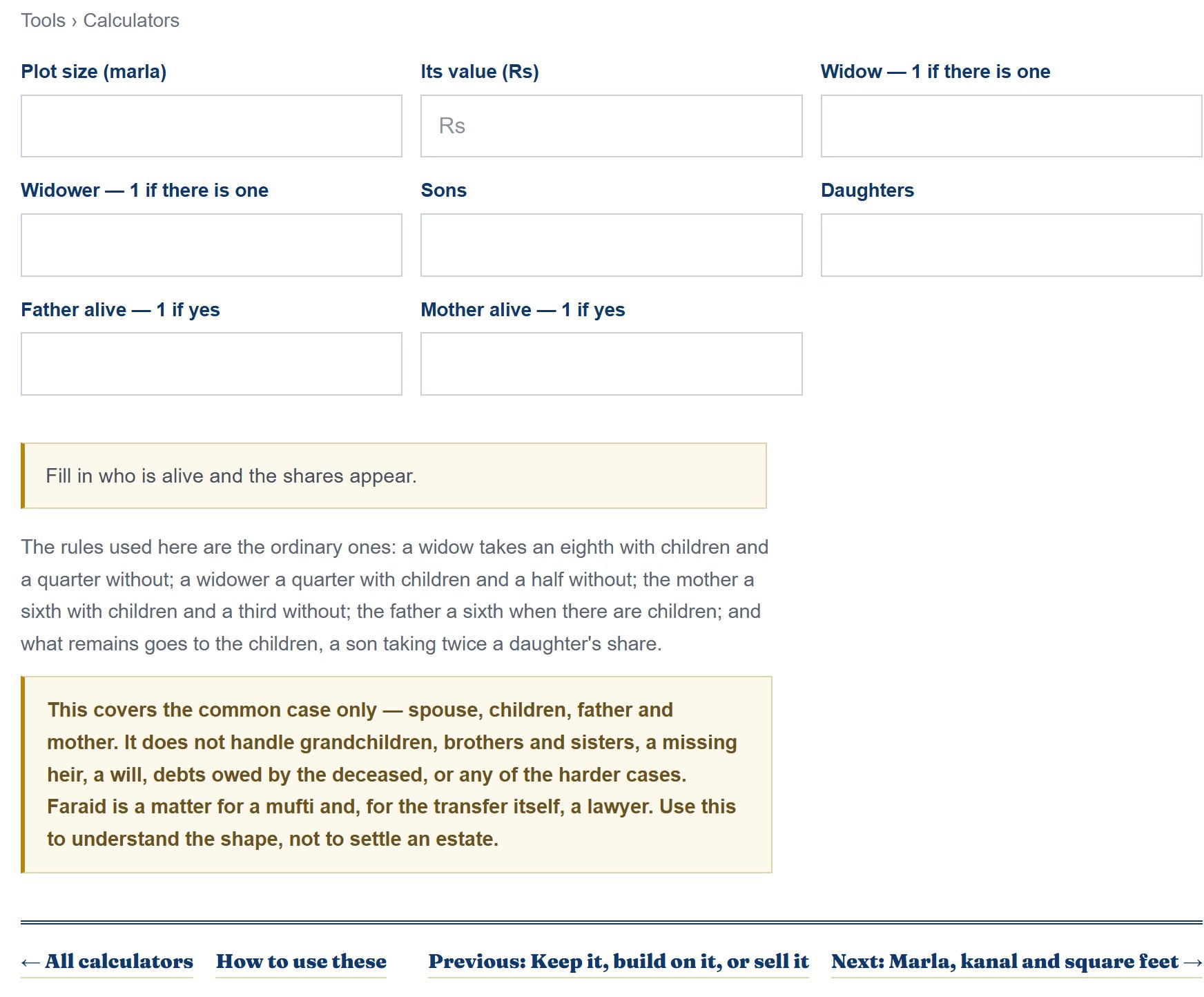
The ordinary rules of faraid, applied to one plot, with each share shown in marla and in rupees. It is here to help a family see the shape of the thing before they sit down — not to settle an estate.
 Open this calculator
01
When to use it
Before a family meeting, so that everyone is looking at the same arithmetic rather than at what somebody remembers being told.
02
Every field, explained
| Plot size (marla) | The whole plot, as DHA's record has it. |
| Its value (Rs) | Today's value. It only converts the shares into rupees; it does not change the fractions. |
| Widow / widower | Enter 1 if there is one. A widow takes an eighth when there are children and a quarter when there are none; a widower a quarter with children and a half without. |
| Sons and daughters | The count of each. What remains after the fixed shares goes to the children, a son taking twice a daughter's share. |
| Father and mother | The mother takes a sixth when there are children and a third when there are none; the father a sixth when there are children. |
03
How the answer is worked out
- The fixed shares are taken out first — spouse, mother, father.
- What remains goes to the children, with a son counted as two daughters.
- If the fixed shares add up to more than the whole, every share is reduced in the same proportion. This is called awl, and the page says so when it happens.
- If something is left over after all the heirs entered, the page says that too, because that case needs a scholar.
A widow, two sons and one daughter
| Plot | 10 marla, Rs 4 crore |
| Widow | one eighth |
| Left for the children | seven eighths |
| Counted as | 2 + 2 + 1 = 5 parts |
The widow gets 1.25 marla (Rs 50 lakh). Each son gets 3.5 marla (Rs 1.4 crore) and the daughter 1.75 marla (Rs 70 lakh).
04
Mistakes people make
- Dividing the plot equally among the children because it feels fairer. The rules are not a suggestion.
- Forgetting the mother or father when they are alive. Their shares come out before the children's.
- Treating the rupee figure as the plan. A plot cannot always be cut on the ground the way the fractions cut it — that is a conversation, and usually a sale.
- Using this where there is a will, a debt, or an heir nobody can find.
05
What it does not do
- It covers the common case only: spouse, children, father, mother.
- Grandchildren, brothers and sisters, a missing heir, a will, the deceased's debts and the harder cases are all outside it.
- It is not a fatwa and not a legal document. Faraid is a matter for a mufti, and the transfer itself for a lawyer.
06
Questions
- Why does a son get twice a daughter's share?
- What is awl?
- Can we just agree something else among ourselves?
That is the rule in faraid. The reasoning behind it belongs to a scholar, not to a calculator.
When the fixed shares add up to more than the whole estate, every share is scaled down in proportion. The page tells you when it has done this — and a case like that should be confirmed by a mufti.
Adults can agree to give away their own share once they know what it is. The point of this page is that everyone knows what it is first.