Islamic Home Financing Calculator — Pakistan
Every field, the formula behind it, and a worked example.
Last updated:
Help › The calculators › Islamic financing beside a normal loan
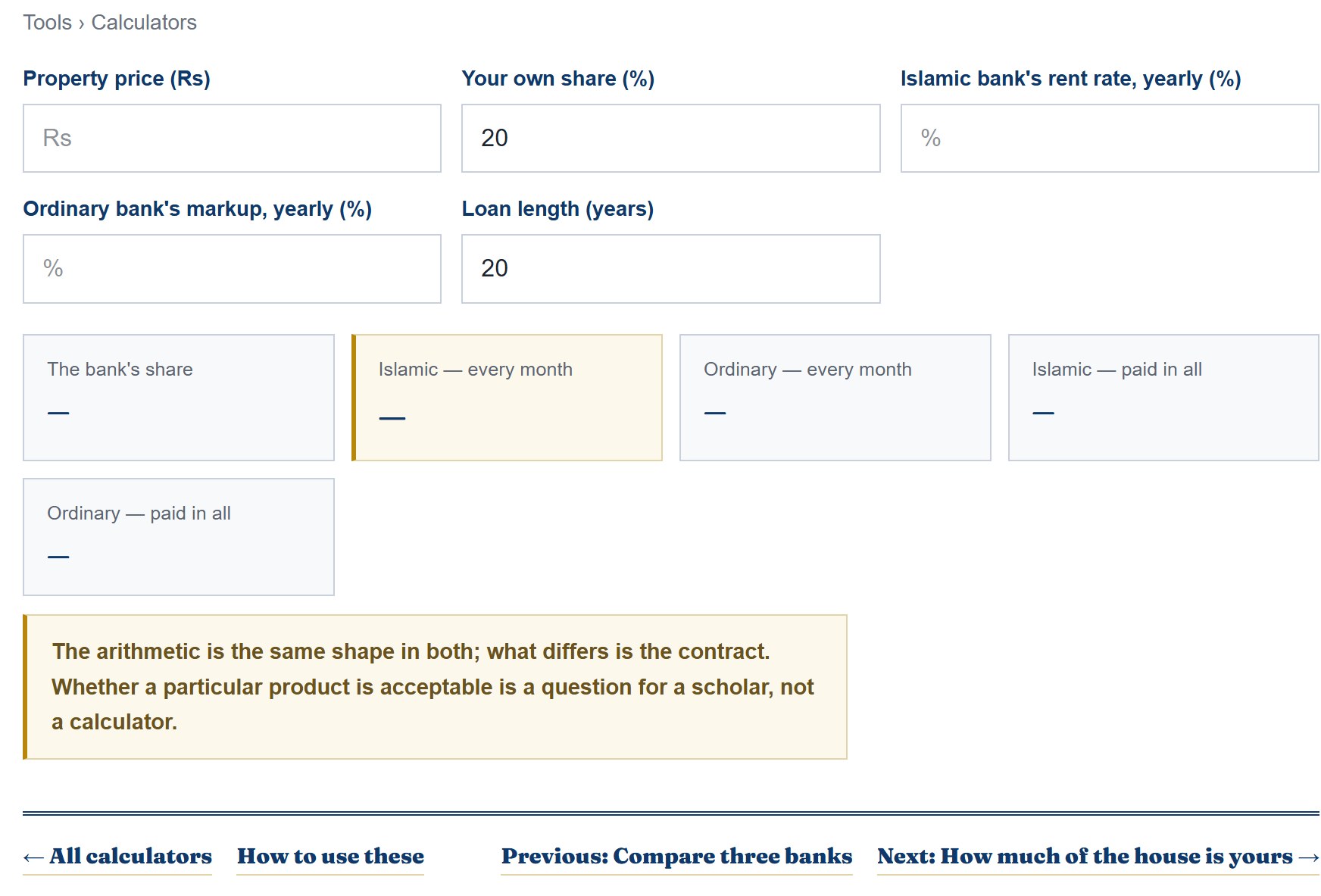
Diminishing musharakah and an ordinary bank loan on the same house, side by side: what each costs every month and in total.
 Open this calculator
01
When to use it
When you want the interest-free route and need to know what, if anything, it costs you compared with the conventional one.
02
Every field, explained
| Property price (Rs) | The full price of the house. |
| Your own share (%) | How much of the house you buy outright at the start. Islamic banks usually want at least 20%. |
| Islamic bank's rent rate, yearly (%) | In diminishing musharakah the bank does not charge markup; it owns a share and charges you rent on it. This is that rate, as the bank quotes it. |
| Ordinary bank's markup, yearly (%) | What a conventional bank quoted you on the same house. |
| Loan length (years) | The same term for both, so the comparison is fair. |
03
How the answer is worked out
- Your share is taken off the price; what remains is the bank's share.
- Both routes are worked out on that same bank share, over the same years — one at the Islamic bank's rent rate, one at the conventional markup.
- The monthly payment and the total paid are shown for both, so the difference is a number rather than an argument.
A worked example
| Price | Rs 3 crore |
| Your share | 20% (Rs 60 lakh) |
| Bank's share | Rs 2.4 crore |
| Islamic rent rate / bank markup | 19% / 20% |
Over 20 years the Islamic route comes to about Rs 3.94 lakh a month and the conventional to about Rs 4.08 lakh. The gap is real but small — the choice is usually made on the contract, not the arithmetic.
04
Mistakes people make
- Comparing different terms or different down payments. Keep both sides identical or the answer means nothing.
- Assuming Islamic must be more expensive. Sometimes it is, sometimes it is not — put the two rates in and look.
- Treating the calculator as a ruling on whether a product is acceptable. It is not.
05
What it does not do
- It does not decide whether a particular product is genuinely Shariah-compliant. That is a question for a scholar, not a calculator.
- It does not model the ownership transfer schedule in detail — it uses the same arithmetic shape for both routes, which is close enough to compare cost.
- It ignores takaful, processing fees and documentation charges on both sides.
06
Questions
- Why does the maths look the same for both?
- Which banks offer this in Pakistan?
Because in practice the payment schedules work out to the same shape. The difference between them is the contract — who owns what, and what happens if things go wrong — not the arithmetic.
Several, including the fully Islamic ones and Islamic windows of conventional banks. We do not list them or their rates, because both change — ask, then put their figures in here.