Rent or Buy Calculator — DHA Lahore
Every field, the formula behind it, and a worked example.
Last updated:
Help › The calculators › Rent or buy
Over the years you actually plan to stay: what renting costs you, what buying costs you, and what you are left holding at the end.
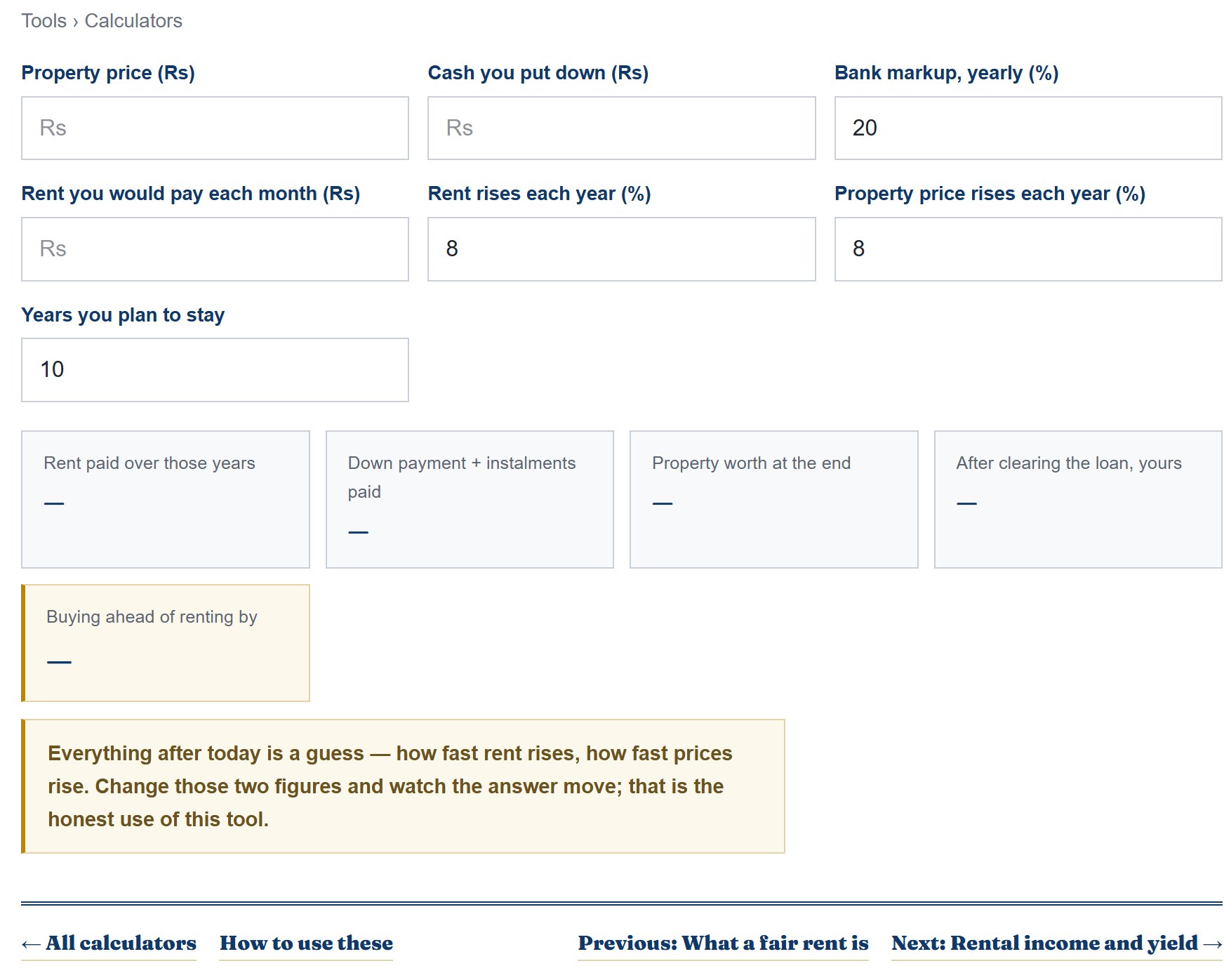 Open this calculator
01
When to use it
The question everyone asks and almost nobody works out. Do it before you commit either way.
02
Every field, explained
| Property price (Rs) | What the house would cost you to buy. |
| Cash you put down (Rs) | Your own money at the start. The rest is assumed borrowed over 20 years. |
| Bank markup, yearly (%) | Your bank's quote on that loan. |
| Rent you would pay each month (Rs) | For a comparable house. The fair-rent checker gives you a real figure rather than a guess. |
| Rent rises each year (%) | How fast you expect rent to climb. 8 is the starting figure, not a prediction. |
| Property price rises each year (%) | The same for prices. This is the single figure the answer is most sensitive to. |
| Years you plan to stay | Be honest. Buying rarely wins over a short stay. |
03
How the answer is worked out
- Renting: the monthly rent is added up year by year, increased by your rent-rise figure each year.
- Buying: your down payment plus every instalment paid during those years.
- At the end, the property's value is grown by your price-rise figure, and whatever loan is still outstanding is subtracted — that is what you would be left holding.
- The last line puts the two together: what you hold at the end, minus what buying cost you, plus the rent you did not have to pay.
A worked example
| Price | Rs 3 crore |
| Down | Rs 1 crore |
| Markup | 20% |
| Rent | Rs 150,000/month |
| Rent and price both rise | 8% a year |
| Staying | 10 years |
Buying comes out well ahead — but change the price rise to 4% and the gap narrows sharply. That is the honest use of this tool: move the two growth figures and watch how much of the answer rests on a guess about the future.
04
Mistakes people make
- Entering a price rise you hope for rather than one you would defend. It is the figure the whole answer swings on.
- Forgetting transfer cost and taxes, which are not in this calculation and are paid on the buying side.
- Putting in a longer stay than you really expect. Buying almost always wins if you stay long enough — which is not a useful answer.
- Ignoring what you could have earned on the down payment if you had not spent it.
05
What it does not do
- It does not include transfer cost, taxes, maintenance, or the money a house needs after you buy it.
- It cannot forecast prices or rents — the two growth boxes are your assumptions, not ours.
- It assumes a 20-year loan and a fixed markup.
- It does not weigh the things that are not money: security, the freedom to change a wall, the freedom to move next year.
06
Questions
- What growth figure should I use?
- Why does renting ever win?
One you would be comfortable defending to someone who disagrees with you. Then try it again two points lower and see whether your decision survives.
Over a short stay, because buying costs are front-loaded — the down payment, the transfer, and early instalments that are nearly all markup.